Designing with Watercolor Baby Hippo Clipart: A Guide to Floral Illustrations and Creative Applications
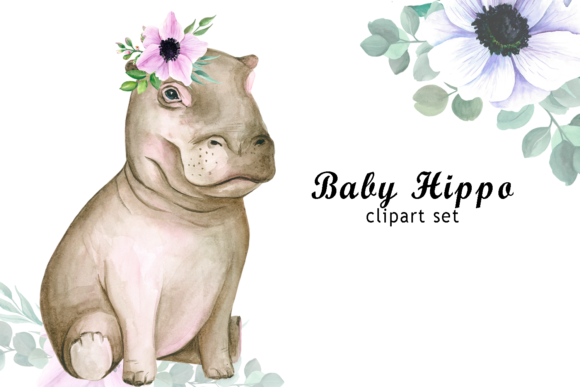
The intersection of whimsical character design and botanical illustration creates a unique aesthetic niche in modern digital art. When creators seek to develop nursery decor, party stationery, or textile prints, the specific combination of fauna and flora offers a softness that vector graphics often cannot replicate. Watercolor baby hippo clipart represents this specialized category, merging the gentle, rounded forms of juvenile wildlife with the organic complexity of hand-painted flowers. Understanding the technical specifications and artistic potential of these assets is essential for designers, educators, and business owners aiming to produce high-quality, emotionally resonant visual content.
The Authenticity of Hand-Painted Digital Assets
In an era dominated by artificial intelligence and purely digital rendering, there is a distinct market preference for authentic, traditional media textures. The primary value proposition of this specific watercolor collection lies in its origin. Unlike digital brushes that simulate paint, these illustrations were physically hand-painted on paper before being digitized. This process preserves the natural grain of the paper, the unpredictable bleeding of pigments, and the subtle variations in opacity that define genuine watercolor art.
For professionals and hobbyists alike, this authenticity translates to superior end products. When scanned at high resolution and meticulously cleaned, the resulting files retain the tactile quality of the original artwork while offering the flexibility of digital manipulation. The transparent backgrounds are crucial here; they allow the intricate edges of the watercolor washes to blend seamlessly into any project without the harsh white boxes associated with standard JPEGs. This preservation of traditional technique ensures that whether the final output is a printed greeting card or a web banner, the viewer perceives the human touch behind the design.
Technical Specifications for Professional Output
Successful integration of clipart into commercial or personal projects depends heavily on file quality. This collection provides twelve distinct files optimized for various scales of production. Understanding these specifications prevents common printing errors such as pixelation or color banding.
- Resolution Standards: All files are rendered at 300dpi (dots per inch). This is the industry standard for professional printing, ensuring crisp edges and smooth color gradients even when viewed up close.
- Large Format Dimensions: Four hippo illustrations are available in substantial sizes, including 12×18, 30×18, and 12×20 inches. These dimensions support large-scale applications like wall art and fabric printing without requiring upscaling algorithms that degrade image quality.
- Botanical Element Sizing: The five individual floral elements and three tropical bouquets vary in size, with bouquets measuring approximately 13×10 and 10×9 inches. These proportions are ideal for framing devices, corner accents, or standalone decorative motifs.
- File Compatibility: Delivered in PNG format with transparency, these assets maintain compatibility across virtually all graphic software ecosystems, from Adobe Photoshop and Illustrator to accessible platforms like Canva and Procreate.
Strategic Applications Across Industries
The versatility of watercolor baby hippo clipart extends far beyond simple decoration. Different sectors utilize these assets to solve specific communication and aesthetic challenges. By analyzing use cases, we can better understand how to leverage the interplay between the animal subjects and the floral accompaniments.
Nursery Design and Child-Centric Environments
In interior design and early childhood education, visual stimuli play a role in emotional regulation and cognitive development. The baby hippo serves as a non-threatening, nurturing archetype. When combined with floral elements, the imagery reinforces themes of nature, growth, and tranquility. Designers creating wall art or educational materials can use the larger 30×18 inch files to create focal points in nurseries or classrooms. The soft color palettes typical of watercolor prevent overstimulation, making them appropriate for rest areas and learning environments. Furthermore, the modular nature of the collection allows educators to create custom storytelling aids, pairing specific hippos with different flowers to teach concepts of matching, seasons, or biology.
Event Stationery and Brand Identity
For the event planning and stationery sector, differentiation is key. Generic templates fail to capture the personalized nature of baby showers, first birthdays, or bridal events. This collection addresses that gap through modularity. A designer might use a central hippo illustration for a birth announcement, flanked by the tropical bouquet elements to create a custom border. For bridal identity, where "hippo" might seem unconventional, the focus can shift entirely to the sophisticated floral bouquets, using the animals only as subtle, playful accents for less formal items like favor tags or menu cards. The ability to mix and match twelve separate files enables the creation of a cohesive brand suite that feels bespoke rather than assembled from stock parts.
Textile and Packaging Design
Print fabrics and product packaging require seamless integration and high-fidelity reproduction. The 300dpi resolution is non-negotiable in this context. When designing surface patterns for textiles, the individual floral elements serve as repeatable motifs, while the hippo illustrations act as placement prints. Because the backgrounds are transparent, designers can layer these elements over colored fabric bases or textured paper packaging without obscuring the substrate's material qualities. This layering capability is particularly valuable for sustainable packaging design, where unbleached or recycled papers provide an earthy backdrop that complements the organic watercolor aesthetic.
Workflow Integration and Composition Techniques
Acquiring high-quality assets is only the first step; effective implementation requires thoughtful composition. Working with hand-painted watercolor elements presents unique considerations compared to working with flat vector graphics.
Managing Transparency and Layering
PNG transparency preserves the delicate outer edges of watercolor blooms, but it also demands careful layer management. When combining the baby hippo with floral bouquets, designers should avoid simply placing one object directly on top of another. Instead, utilize blending modes or masking techniques to integrate the elements. For example, allowing a flower stem to visually tuck behind the hippo’s ear creates depth and suggests a relationship between the subject and the environment. Since these images were painted separately, the artist must act as the compositor, adjusting hue and saturation slightly to ensure the lighting appears consistent across all twelve files.
Scaling and Negative Space
The varying dimensions of the included files encourage dynamic layouts. Utilizing the massive 30×18 inch hippo file as a background element with reduced opacity can create a watermark effect for stationery, while the smaller floral elements provide sharp foreground detail. Conversely, leaving ample negative space around the central subjects is vital. Watercolor relies on the contrast between pigment and paper; crowding the composition with too many digital elements negates the medium's inherent breathability. Effective design with this collection often involves restraint, allowing the texture of the scan and the fluidity of the paint to serve as the primary visual interest.
Considerations for Commercial and Personal Use
While the artistic and technical attributes of watercolor baby hippo clipart are robust, users must approach their projects with practical awareness. The hand-painted nature means that no two elements will have identical edge characteristics. This inconsistency is a feature, not a bug, but it requires designers to abandon the pursuit of mathematical perfection. Aligning elements should be done by eye rather than by grid snapping to maintain the organic feel.
Additionally, color management is critical. Watercolors scanned from paper may appear differently on calibrated monitors versus uncalibrated screens, and even more so when translated to CMYK for print. Professionals should always request or create physical proofs when using these assets for commercial packaging or wall art to verify that the delicate pastel tones translate accurately from screen to substrate. For digital-only applications like web design or social media, maintaining RGB color profiles ensures the vibrancy of the tropical bouquets remains intact.
Finally, the thematic specificity of this collection—baby hippos and tropical florals—dictates its audience. While versatile, it carries a strong connotation of youth, warmth, and celebration. Designers working on corporate, somber, or highly technical projects should evaluate whether this aesthetic aligns with their messaging. However, for those operating within the spheres of family, celebration, education, and artisanal goods, this fusion of zoological charm and botanical elegance provides a rich foundation for creative expression. By respecting the source material's traditional roots and leveraging modern digital workflows, creators can transform these twelve static files into limitless, unique designs that resonate deeply with their intended audiences.